Navy Veteran Jerrad Christian for Congress in Ohio's 12th District!
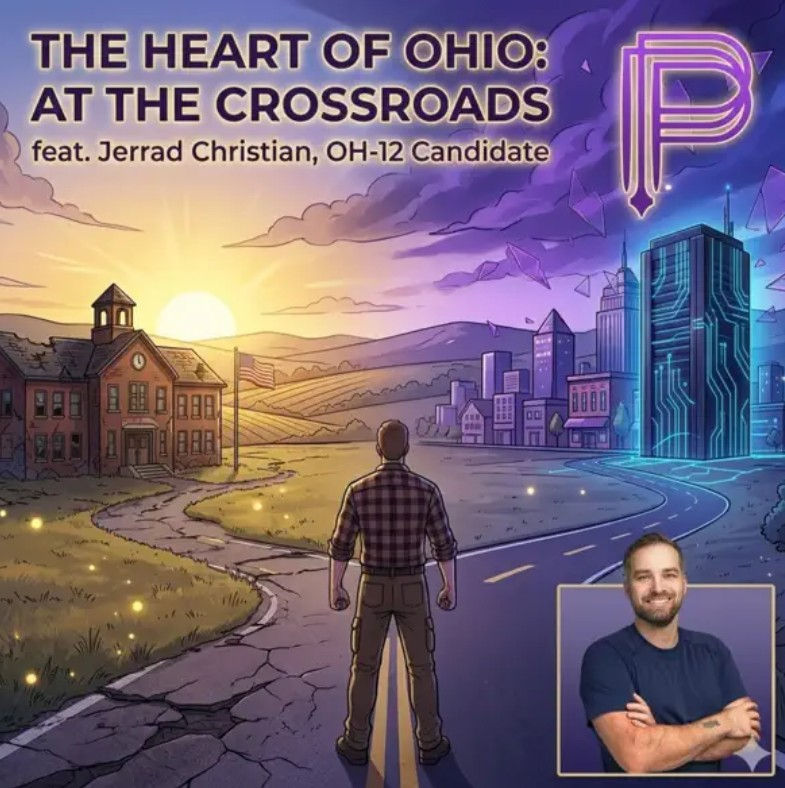
If you're in to podcasts and/or in Ohio, here's a n interview to check out! "Can a Working Class Veteran Fix Ohio's Broken Politics?" Radell Lewis and the Purple Political Breakdown interviewed Jerrad Christian, a Navy veteran and self-taught software engineer running for Congress in Ohio's 12th District.
He grew up in Appalachian poverty, worked as a janitor, and is now challenging a system that's been run by one party for 40 years. Here's what he had to say.
From Radell Lewis:
I host the Purple Political Breakdown podcast, a nonpartisan political analysis show where we sit down with candidates, analysts, and everyday people to break down the issues that actually matter. Our tagline is "Political Solutions Without Political Bias," and we mean it. We are not here to cheerlead for a party. We are here to ask hard questions and let people decide for themselves.
This week I sat down with Jerrad Christian, a Democratic candidate running for Ohio's 12th Congressional District in the 2026 midterms. His story is one that a lot of Americans can relate to, even if the details are different. He grew up in rural Appalachian Ohio in a working poor family. Government programs were not abstract policy debates in his household. They were the difference between eating and not eating. He couch surfed as a kid and watched his mom fight cancer with Medicare keeping her alive.
He joined the U.S. Navy and served as a flight deck fueler on a carrier during Operation Iraqi Freedom, then later worked as a meteorologist and oceanographer. After getting out and becoming a father, he took a job as a janitor in a factory. While working that job, he taught himself software engineering on the internet, went through a tech program for job placement, and has been a software engineer for about eight years now. He is not wealthy. He just worked his way to stability and wants that kind of upward mobility to be the norm, not the exception.
We covered a lot of ground in the conversation, and I want to lay out the key topics for anyone interested in Ohio politics, the 2026 midterms, or just the state of American governance right now.
**GERRYMANDERING AND THE OHIO MAP COMPROMISE**
Jerrad's district, the 12th, stretches from half of Delaware County all the way to the West Virginia border in Monroe County. He described it as shaped like a Tetris Z, about three hours from one side to the other, covering everything from Amish country in Holmes County to Perry County at the southern end. We talked about the gerrymandering compromise that took place in Ohio, where Republicans offered a map that Democrats had to accept because the alternative would have been even worse. Jerrad admitted he was initially angry about the deal but came to understand the practical reality: when someone has a gun to your head politically, your options are limited. He made the point that gerrymandering, regardless of which party does it, creates safe seats that kill representation. Politicians get comfortable with power or comfortable without it, and they stop doing the work.
**UNIVERSAL HEALTHCARE AND THE SINGLE PAYER MODEL**
One of his core platform issues is universal healthcare through a single payer insurance model. He was clear that he does not want the government running hospitals, just acting as the insurance provider. He argued that the U.S. pays the most per capita for healthcare of any nation and is the only developed country without universal coverage. His response to the wait times argument was sharp: wait times in America seem short because people are not even getting in line. They are dying before they ever see a doctor. People without insurance skip care entirely, and when they do need emergency treatment, the costs get passed on to everyone else. He referenced the book "The Deficit Myth" by Stephanie Kelton and discussed modern monetary theory, arguing that the government can invest in healthcare without the tax burden people fear, especially if we stop cutting taxes for the wealthiest Americans and start spending on economic growth instead. His key selling point: you would pay less in a tax increase for universal healthcare than you currently pay in monthly insurance premiums.
**PROPERTY TAXES AND PUBLIC EDUCATION FUNDING**
We got into the property tax crisis in Ohio, which ties directly into education funding. Jerrad pointed out that Ohio's Supreme Court ruled the state's education funding method unconstitutional back in the 1990s, and it has been ruled unconstitutional multiple times since. The same party has been in charge the entire time and done nothing to fix it. He connected the dots between income tax cuts for the wealthiest Ohioans, tax abatements for data centers that bring almost no jobs but drain water and raise power bills, and the resulting budget pressure that gets dumped on property owners. Ohio recently moved to a flat income tax of about 2.5%, which helped the people at the top far more than those at the bottom, since the upper brackets were previously much higher. He warned that if the proposed property tax ban goes into the Ohio Constitution, the state will face a budget crisis, and sales taxes and income taxes will have to go back up to compensate.
**SCHOOL VOUCHERS AND THE PRIVATIZATION OF EDUCATION**
Jerrad was blunt about the voucher system. He noted that roughly 90% of voucher users were already attending private schools, meaning the program is effectively subsidizing wealthy families with public money. He pointed out that the Ohio Constitution explicitly prohibits funding religious schools with education dollars, but the current leadership is ignoring that provision. He drew an analogy: if you do not like the public park, the government is not going to build you a private park in your yard. If you do not like the police, the government is not going to hire you a personal bodyguard. Public education serves everyone, and private schools get to pick and choose their students, which skews any performance comparison. A bipartisan education funding bill was in progress in Ohio, but the push for vouchers redirected that money to private institutions connected to political allies.
**MONEY IN POLITICS AND CITIZENS UNITED**
He is firmly in favor of overturning Citizens United and eliminating super PACs. He also supports ending congressional stock trading. He pointed to FEC reports showing $3,000 dinners and cross country travel funded by corporate donors and PACs. His fundamental position is that representatives are elected to serve people, not the businesses that fill their campaign accounts.
**THE STATE OF THE DEMOCRATIC PARTY**
I asked him how he plans to change the image of Democrats, given that public opinion of the party is low even as Republicans face record disapproval. His answer was grounded in local reality. He noted that Ohio has been run by Republicans for 40 years, and you cannot name a Democrat who has been the problem in this state. He talked about meeting local Democratic organizers who have been doing the work quietly for years: collecting canned goods, setting up community meetings, trying to elect people who care about their communities. His point was that the national brand does not represent who he is. AOC has never been on his ballot. Nancy Pelosi has never been on his ballot. He is from middle of nowhere Appalachia, not New York or DC.
**DEALING WITH MAGA AND THE TRUMP ADMINISTRATION**
For the final question, I asked how he would deal with MAGA if elected, given that Trump will still be in office for two more years regardless of midterm outcomes. He drew a distinction between MAGA politicians and MAGA voters. He believes many politicians who claim the MAGA label are simply opportunists riding a wave for power, and that once the movement loses steam, they will either settle down or lose their seats. For everyday voters who identify as MAGA, he sees people who are tired of being ignored, who want honesty and protection for their communities. He said he would be willing to go to other districts and hold representatives accountable publicly if they are failing their people.
He closed by saying he believes the heart of America is still good, that people are afraid because of the affordability crisis, and that social media algorithms have weaponized division for profit. He is running because he refuses to hand his son a country hollowed out by corruption, cruelty, and short term thinking.
This is the kind of conversation I think more people need to hear, regardless of where they fall politically. If you are interested in Ohio politics, the 2026 midterms, or just want to hear a working class candidate speak honestly about the problems facing this country, give this episode a listen.
Learn more about Jerrad's campaign: [https://ChristianForOhio.com](https://ChristianForOhio.com)
Purple Political Breakdown: Political Solutions Without Political Bias.
Website: [purplepoliticalbreakdown.com](http://purplepoliticalbreakdown.com)
**SOURCES:**
**U.S. Healthcare Spending Per Capita:** Peterson-KFF Health System Tracker, "How does health spending in the U.S. compare to other countries?" [https://www.healthsystemtracker.org/chart-collection/health-spending-u-s-compare-countries/](https://www.healthsystemtracker.org/chart-collection/health-spending-u-s-compare-countries/)
**U.S. as Only Developed Nation Without Universal Healthcare:** The Commonwealth Fund, "Mirror, Mirror 2024: A Portrait of the Failing U.S. Health System." [https://www.commonwealthfund.org/publications/fund-reports/2024/sep/mirror-mirror-2024](https://www.commonwealthfund.org/publications/fund-reports/2024/sep/mirror-mirror-2024)
**Ohio Education Funding Ruled Unconstitutional (DeRolph v. State):** DeRolph v. State of Ohio, 78 Ohio St. 3d 193 (1997). [https://www.supremecourt.ohio.gov/rod/docs/pdf/0/1997/1997-Ohio-84.pdf](https://www.supremecourt.ohio.gov/rod/docs/pdf/0/1997/1997-Ohio-84.pdf)
**Ohio School Voucher Data (EdChoice Scholarship):** Innovation Ohio analysis of EdChoice enrollment data. [https://innovationohio.org](https://innovationohio.org)
**Ohio Flat Income Tax:** Ohio Legislative Service Commission, tax rate information. [https://www.lsc.ohio.gov](https://www.lsc.ohio.gov)
**Citizens United v. FEC, 558 U.S. 310 (2010):** [https://supreme.justia.com/cases/federal/us/558/310/](https://supreme.justia.com/cases/federal/us/558/310/)
**The Deficit Myth by Stephanie Kelton:** Kelton, Stephanie. "The Deficit Myth: Modern Monetary Theory and the Birth of the People's Economy." PublicAffairs, 2020. [https://stephaniekelton.com/book/](https://stephaniekelton.com/book/)
**Ohio Gerrymandering and Redistricting:** Ohio Redistricting Commission proceedings and Ohio Supreme Court rulings (2021 to 2024). [https://www.redistricting.ohio.gov](https://www.redistricting.ohio.gov)
**Ohio Property Tax and Data Center Tax Abatements:** Policy Matters Ohio reporting. [https://www.policymattersohio.org](https://www.policymattersohio.org)
**FirstEnergy Corruption Case (HB 6):** U.S. Department of Justice, U.S. v. Householder et al. [https://www.justice.gov/usao-sdoh/pr/ohio-house-speaker-larry-householder-and-4-others-arrested-connection-60-million](https://www.justice.gov/usao-sdoh/pr/ohio-house-speaker-larry-householder-and-4-others-arrested-connection-60-million)
**Ohio Boneless Wings Case (Berkheimer v. RRHI, 2023):** Ohio Supreme Court decision. [https://www.supremecourt.ohio.gov/rod/docs/pdf/0/2023/2023-Ohio-4525.pdf](https://www.supremecourt.ohio.gov/rod/docs/pdf/0/2023/2023-Ohio-4525.pdf)
**Congressional Salary ($174,000):** Congressional Research Service. [https://crsreports.congress.gov/product/pdf/RL/RL30064](https://crsreports.congress.gov/product/pdf/RL/RL30064)
Get with US! #VeteransAgainstTyranny
🙏 LIKE / SHARE / SUBSCRIBE!
🔥JOIN US! OR ❤️DONATE!
⬇️ BECOME A MEMBER TODAY! ⬇️


Comments